By: Ranen Salikram / Candidate Attorney / Mooney Ford Attorneys
You sign a car rental agreement at the airport counter. You initial a dozen boxes without reading them, take the keys, and drive off. A week later the car is damaged in an accident you are convinced was not your fault, and the rental company hands you a bill for the full cost of the repairs. You protest that you did nothing wrong. The company points to a clause you signed. Who wins?
The answer, more often than not, is the rental company. The reason says a great deal about how South African law treats the contracts we sign every day.
The Clause That Catches Everyone Off Guard
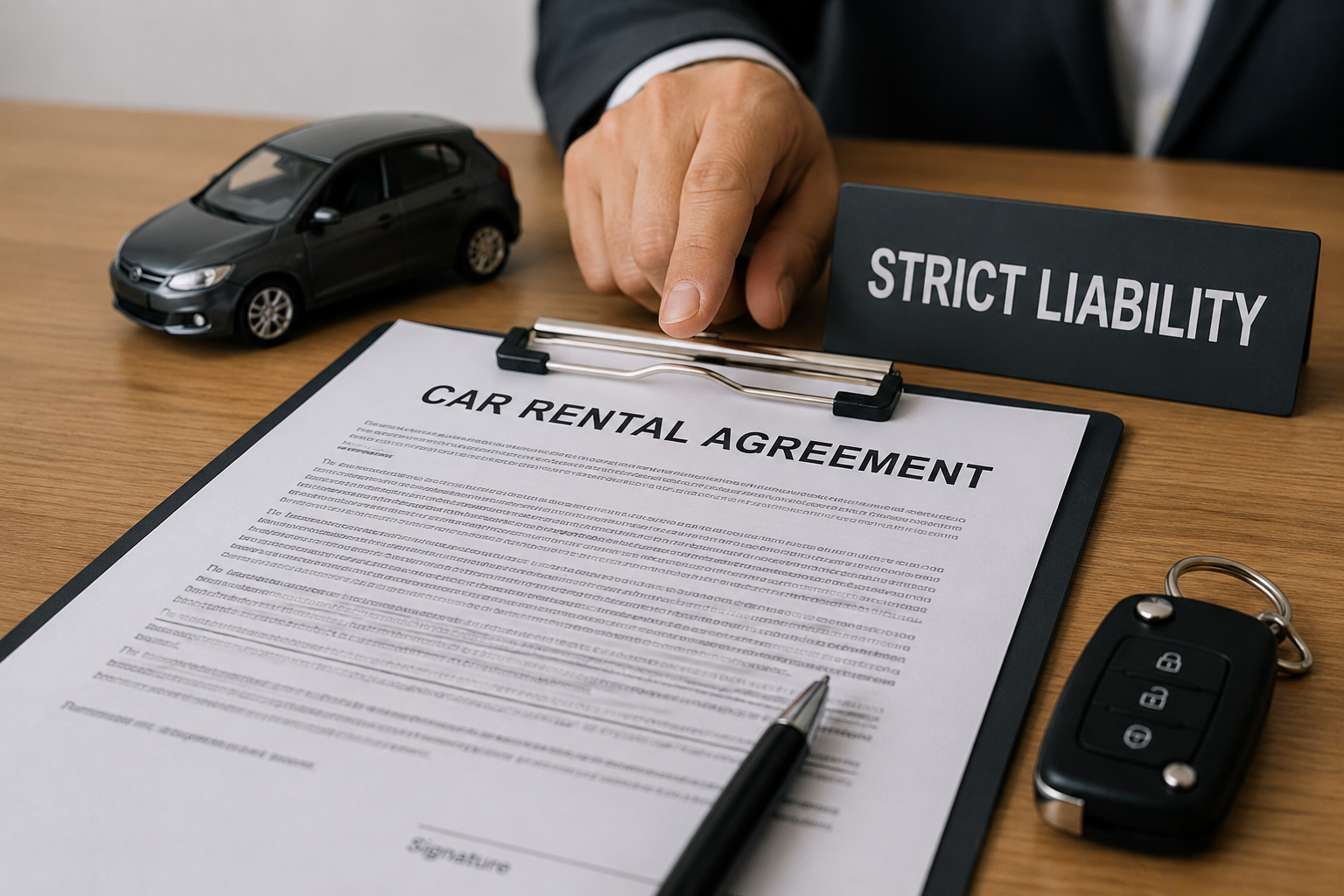
Most major car rental agreements contain what lawyers call a strict liability clause. In plain terms, it makes the renter responsible for certain categories of damage regardless of whether they were at fault. The most common version applies to single-vehicle damage: the car rolls, leaves the road, strikes a fixed object, or is otherwise damaged without a collision with another identifiable vehicle.
This is not a quirk of one company’s fine print. It is an industry standard. The published terms of the largest car rental companies operating in South Africa contain materially similar provisions: some make the client liable for all damage whether or not it was caused by their fault, others provide that the renter assumes the risk in the vehicle from the moment it is handed over. The wording differs, but the principle is consistent across the market: where a vehicle is damaged in a single-vehicle incident, the renter generally pays.
For many people this feels deeply unfair. If a motor vehicle cuts in front of you on the highway and you swerve to avoid a collision, only to strike the barrier, why should you carry the cost? You reacted as any reasonable driver would, and the accident was, in a real sense, not your fault.
That instinct is understandable. But South African law draws a sharp distinction between a contract that is unfair and a contract that the courts will refuse to enforce. They are not the same thing.
Unfair Is Not the Same as Unenforceable
The starting point of our law of contract is a principle with an old Latin name: pacta sunt servanda, which means that agreements must be kept. The Constitutional Court has explained that the freedom to bind yourself to a contract is an expression of personal autonomy and dignity. A court will not enforce a contract that is contrary to public policy, but the threshold is high and deliberately so. In Sasfin (Pty) Ltd v Beukes, the then Appellate Division held that this power must be exercised sparingly and only in the clearest of cases, where the harm to the public is substantially incontestable; a contract is not contrary to public policy merely because its terms offend one’s sense of fairness. This is the trap the “it wasn’t my fault” argument falls into. The renter is really arguing that the clause is unfair to them, but the test is whether it is clearly inimical to the interests of the community as a whole, and personal hardship does not answer that question.
The Constitutional Court put the matter beyond doubt in Beadica 231 CC v Trustees for the time being of the Oregon Trust in 2020. A court, it held, may not refuse to enforce contractual terms on the basis that enforcement would, in its subjective view, be unfair, unreasonable or unduly harsh. The burden rests on the party attacking the contract to show that enforcement would harm the community; the rental company does not have to justify the clause. There is a deeper reason for this. Certainty in contracts is itself a constitutional value, because our economy depends on people being able to trust that agreements will be honoured. Enforcing contracts is not the enemy of justice; it is part of how a fair and functioning society works.
Why the Clause Exists at All
These clauses are not simply a way for rental companies to extract money from customers. There is a genuine commercial logic to them, and it explains why the courts treat them as legitimate. When a vehicle is damaged in a collision with another car, there is an external event that can be investigated: witnesses, another driver, physical evidence, perhaps camera footage. A single-vehicle incident is different. The car comes back damaged and the only account of what happened is the renter’s own, with no independent witness and a clear incentive to describe events favourably. Strict liability is a rational response to that imbalance, and it answers a problem economists call moral hazard: a driver who knows they will only be liable if negligence is proved has less reason to treat a rental car with the care they would give their own. The clause places the cost on the person who had exclusive control of the vehicle and made the decisions that led to the damage.
And the risk is not trivial. Data published by the Road Traffic Management Corporation shows that single-vehicle incidents make up a substantial share of fatal crashes in South Africa. Taken together, single-vehicle overturning, vehicles striking fixed objects, and vehicles leaving the road account for over twenty percent of fatal crashes. These are common events, not freak occurrences, and a rental business that could not allocate that risk would struggle to offer vehicles at affordable rates.
What This Means for You
The practical lesson is straightforward: the strict liability clause is real, it is enforceable, and the argument that an accident was not your fault will rarely get you out of it. But there is a second lesson that matters just as much, and it concerns how renters try to protect themselves.
Rental companies almost always offer what they call a waiver, and this is where the most dangerous misconception arises. A waiver is not insurance. It is easy to assume that paying the extra fee means you are covered no matter what happens, but that is not how a waiver works. A waiver is a limited contractual concession by which the rental company agrees to reduce the amount you would otherwise owe, and it almost always comes with significant exclusions. Many waivers fall away entirely in the very situations most likely to occur in a single-vehicle accident: where the vehicle strikes an object, a person, or another vehicle, where it leaves the road, or where it overturns. A renter who paid for the waiver and believed they were protected can still be held liable for the full cost of the damage.
If you genuinely want to protect yourself against liability for damage to a rented vehicle, the answer is not to rely on the waiver. It is to arrange proper insurance. A separate policy for the rented vehicle, whether through your own short-term insurer, a travel insurance product, or a credit card that provides rental cover, is the only thing that functions as real insurance against this risk. Unlike a waiver, an insurance policy is a contract of indemnity designed to cover you where a waiver leaves you exposed. The distinction is not academic. It is the difference between thinking you are covered and actually being covered.
So read the agreement. Ask what the strict liability clause covers, and ask exactly what the waiver excludes. Do not mistake a waiver for insurance, and if you want real protection, arrange it before you collect the keys. Because once you have signed and driven off, “it wasn’t my fault” is, in the eyes of the law, very often beside the point.