by Kaylen Moodley / Associate / Mooney Ford Attorneys
INTRODUCTION
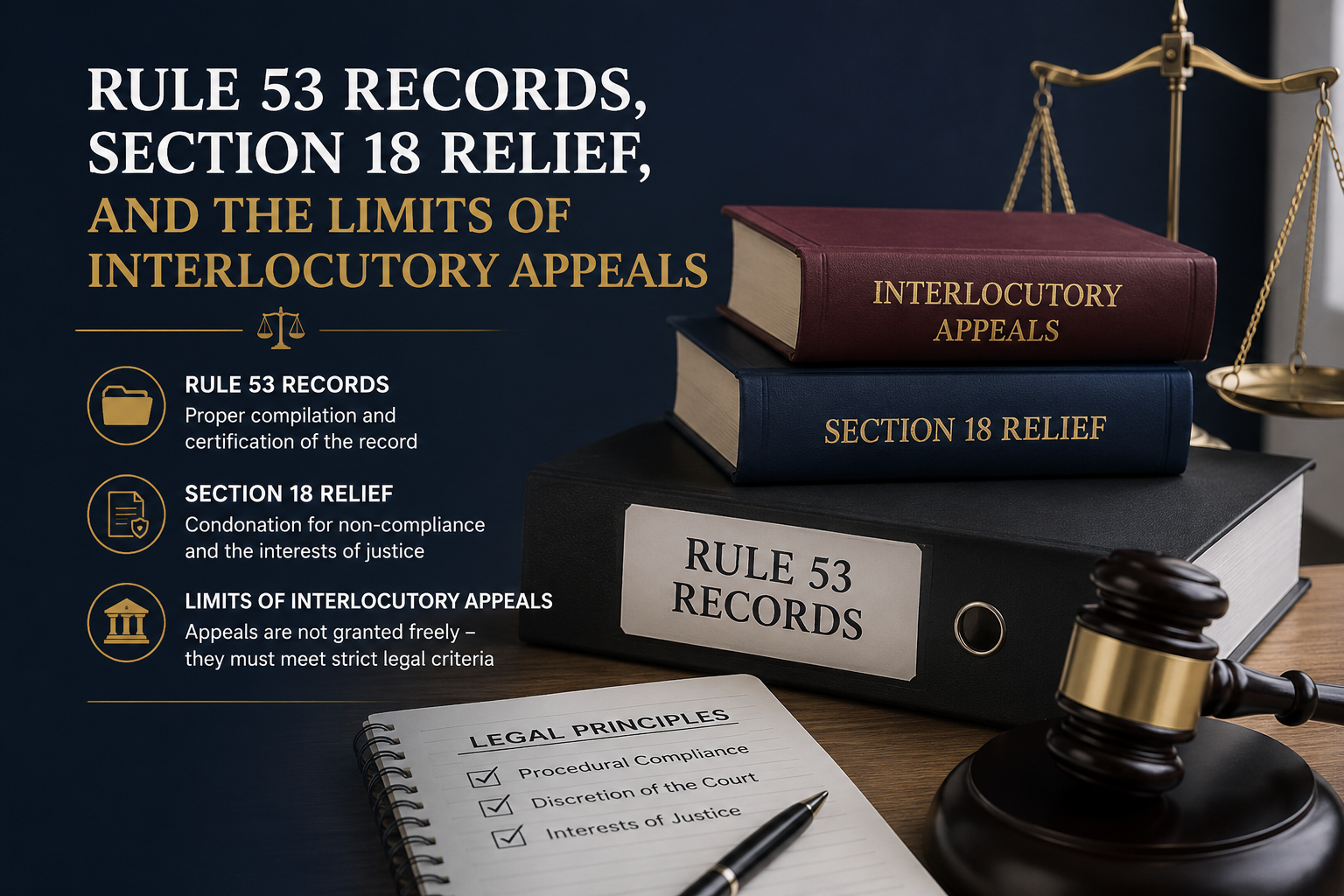
The judgment of Du Plessis J in Transnet SOC Limited v Fidelity Security Services (Pty) Ltd and Others, delivered on 2 May 2026, provides insight into the issue of the suspension of an interlocutory order under section 18 of the Superior Courts Act 10 of 2013.
Although the judgment is not marked as reportable, it is of real practical importance. It deals with the attempted suspension of an order compelling Transnet to produce a Rule 53 record in a public procurement review. The judgment is particularly important because Transnet sought to rely on the Constitutional Court’s decision in Famous Idea Trading 4 (Pty) Ltd t/a Dely Road Courier Pharmacy v Government Employees Medical Scheme and Others [2026] ZACC 5 (“Famous Idea”), contending that the court which compelled production of the record had incorrectly relied on Murray NNO v Ntombela [2024] ZASCA 24.
The court rejected that argument and dismissed the application, with costs on Scale C.
THE RULE 53 PROVISION UNDER SCRUTINY
The relevant portion of Rule 53(1)(b) provides that the notice of motion must call upon the relevant decision-maker:
“to despatch, within 15 days after receipt of the notice of motion, to the registrar the record of such proceedings sought to be corrected or set aside, together with such reasons as the magistrate, presiding officer, chairperson or officer, as the case may be is by law required or desires to give or make, and to notify the applicant that such magistrate, presiding officer, chairperson or officer, as the case may be has done so.”
This is the procedural mechanism which sat at the centre of the dispute. Fidelity Security Services (Pty) Ltd (“Fidelity”) wanted the record of the tender process. Transnet resisted production. Fidelity then obtained an order before Windell J on 7 April 2026, compelling Transnet to dispatch the Rule 53 record within ten days.
Transnet sought leave to appeal that order. However, because the order was interlocutory, the application for leave to appeal did not automatically suspend its operation. Transnet therefore launched an urgent application under section 18(3) to suspend the order pending the appeal process.
BACKGROUND
The underlying matter concerned a tender process. Fidelity had participated in the tender but was unsuccessful. It then instituted review proceedings in May 2025 to challenge Transnet’s conduct in adjudicating and awarding the tender.
Fidelity’s complaint was that its bid had either been treated as non-responsive, or had otherwise been rejected unlawfully, unfairly and irrationally. Importantly, Fidelity’s position was that it could not properly know the full basis upon which its bid had failed without access to the record.
That is precisely why Rule 53 exists. It prevents a review applicant from being forced to litigate in the dark. It allows the applicant to see what served before the decision-maker, what was considered, what was ignored, and how the impugned decision was reached.
Transnet, however, disputed the existence of the decision pleaded by Fidelity and contended that Fidelity’s founding affidavit did not lay a sufficient factual basis for the review grounds relied upon. On that basis, it refused to furnish the record.
SECTION 18 OF THE SUPERIOR COURTS ACT: THE HIGH THRESHOLD
The court had to consider the requirements of section 18(2) and 18(3) of the Superior Courts Act.
Section 18(2) provides that the operation and execution of an interlocutory order not having the effect of a final judgment is not suspended pending an application for leave to appeal or an appeal, unless the court orders otherwise under exceptional circumstances.
Section 18(3) then requires the applicant to prove, on a balance of probabilities, that:
First, it will suffer irreparable harm if the order is not suspended; and secondly, that the other party will not suffer irreparable harm if the order is suspended.
The test is therefore deliberately stringent. A party cannot simply say: “We intend to appeal” or “we believe the court was wrong”. Something more is required. The applicant must show truly exceptional circumstances, supported by facts, and not merely by broad assertions.
TRANSNET’S RELIANCE ON FAMOUS IDEA
Transnet’s main argument was that Windell J’s order compelling production of the record was inconsistent with the Constitutional Court’s decision in Famous Idea. Transnet argued that Famous Idea required the court to determine, before ordering production of a Rule 53 record, whether the founding affidavit established review jurisdiction by identifying a reviewable decision and setting out a proper factual basis for the review.
Du Plessis J rejected this as an overstated reading of Famous Idea.
The court drew an important distinction between a true jurisdictional objection and a factual dispute about the existence or characterisation of the decision pleaded. In Famous Idea, the issue was whether the impugned conduct was reviewable at all. The point went to the court’s review jurisdiction. In other words, the question was whether there was administrative action, public power, or some legally reviewable decision in the first place.
That was not the same issue before Du Plessis J.
Transnet did not contend that a decision to disqualify Fidelity’s bid, or to treat it as non-responsive, would fall outside PAJA if such a decision existed. Its complaint was rather that the decision pleaded by Fidelity did not exist in the form alleged. That, the court held, was not the type of jurisdictional objection contemplated in Famous Idea.
This is one of the most important aspects of the judgment. It prevents Famous Idea from being used as a general-purpose weapon to resist Rule 53 records in procurement reviews.
CONFIDENTIALITY WAS NOT ENOUGH
Transnet also argued that the record contained confidential tender information, including bid submissions, pricing, technical proposals, evaluation matrices, minutes, reports and recommendations. Its point was that once Fidelity saw the information, it could not be “unseen”.
The court was not persuaded.
The difficulty for Transnet was that the confidentiality argument was advanced at a high level of generality. Transnet identified broad categories of documents, but did not identify specific documents or specific portions of documents that were confidential, privileged, irrelevant or deserving of protection.
The court also took issue with the fact that Transnet had not, at the stage when the production order was sought, advanced a case for limited disclosure, redaction, a confidentiality regime, or the exclusion of identified material. Instead, it resisted production of the record in its entirety.
That was insufficient.
The practical lesson is clear: where a party genuinely seeks to protect confidential material in a Rule 53 record, it must do so properly. It must identify the material, explain the harm, and propose a workable protective mechanism. A blanket refusal to produce the record is unlikely to find favour with the court.
PREJUDICE TO FIDELITY
The court also accepted that Fidelity would suffer real prejudice if the order was suspended. The tender concerned a limited-term contract. Fidelity could not properly prosecute its review without the record. Any delay in producing the record would entrench the practical consequences of the tender award and undermine Fidelity’s ability to ventilate its case.
This is an important point in procurement litigation. Time is often decisive. If the record is delayed for months while interlocutory appeals are pursued, the review may become commercially hollow. By the time the matter is heard, the contract may already be substantially performed.
The court therefore recognised that withholding the record does not merely preserve the status quo. It may actively prejudice the review applicant.
IMPLICATIONS OF THE JUDGMENT
The judgment has several practical implications.
First, Rule 53 remains central to meaningful review proceedings. A review applicant, particularly in a tender matter, is ordinarily entitled to the record so that it may understand and challenge the decision properly.
Secondly, Famous Idea must not be overstretched. It applies where there is a proper jurisdictional objection to the review itself. It does not mean that every respondent can avoid producing the record simply by disputing the applicant’s pleaded version.
Thirdly, confidentiality must be pleaded with precision. A party cannot rely on broad references to pricing, bid documents or technical information. If confidentiality is genuinely implicated, the party must identify the documents, explain the harm, and propose redactions or a confidentiality regime.
Fourthly, section 18 relief remains extraordinary. The fact that an appeal is pending does not, without more, justify suspending an interlocutory order. The applicant must prove exceptional circumstances and irreparable harm.
Finally, the judgment sends a clear message to public entities involved in procurement reviews: the record of the decision-making process is not something to be withheld. It is often the very foundation upon which the legality of the procurement decision must be tested.
CONCLUSION
The judgment is a firm and practical restatement of the purpose of Rule 53 and the strictness of section 18.
Transnet’s difficulty was that it tried to convert a dispute about the production of a review record into an exceptional case warranting suspension. The court was not persuaded. Its reliance on Famous Idea was too broad, its confidentiality complaint was too general, and its harm case was not sufficiently particularised.
The broader principle emerging from the judgment is simple: a party who seeks to resist a Rule 53 record must do so with precision, not generality. A party that seeks section 18 relief must prove exceptional circumstances, not merely assert them. And a public body whose decision is under review must appreciate that the record is not a procedural inconvenience: it is the means by which legality, rationality and fairness are tested.